
|
|

|
The Company that invented the KAMAS™ Software
KAMAS is a Knowledge And Mind Amplification System™. This software originated as a product in the early days of personal computing. KAMAS was invented and marketed by Kamasoft as an outline-based (hierarchical) knowledge organizing and manipulation tool. The flagship versions of KAMAS were fully programmable text/knowledge management systems. Spanning from 1983 to 1989 the company offered several versions of its KAMAS and Out-Think products for the CP/M, IBM PC-DOS, and Microsoft MS-DOS operating systems. Kamasoft was founded as a partnership of Adam Trent (President, product design, software engineering, tech support) and Dorothy Anne Hickman (Vice President, tech writing, marketing, accounting). At its peak in 1986, Kamasoft was offering its products and publishing a support newsletter to a worldwide community of users.
The very earliest hierarchical data retrieval software technology which became the core innovation in KAMAS was invented and coded in the BASIC programming language on a MITS-Altair computer in 1980 by software engineer Adam Trent. Starting with full-time development in 1981, the core KAMAS technology evolved in various incarnations as coded in a personal computer implementation of the BASIC programming language offered by a company called Micropolis. With the advent of the Digital Research CP/M operating system on personal computers, the KAMAS technology was recoded numerous times to aim at that early blossoming market. When feasibility of KAMAS's inner search and hierarchical data storage algorithms was thereby confirmed on the relatively slow 8-bit microprocessors of the time, the implementation culminated in a Z80 Assembly Language virtual machine kernel whereby KAMAS became self-programmable in its own built-in Forth-derived programming language. The KAMAS Language was a unique and powerful self-extensible programming language with an Indirect Threaded Code interpreter at its core. Thus the first published version of KAMAS was coded almost entirely in the KAMAS language itself.
KAMAS was launched as a product in 1984 for the expanding variety of personal computers then running the CP/M operating system. After rave reviews in various of the personal computing magazines of the day (eg, Infoworld, Byte Magazine), Kamasoft was off and flying especially with success serving the exploding user bases of the Kaypro and Osborne portable CP/M computers. Because KAMAS was programmable, it was an application development platform for text-based applications. Its programming language was itself uniquely user-extensible. KAMAS's utility was especially powerful in applications requiring fast search and retrieval into deep hierarchical organizations of huge amounts of text content. It found its best fit home in such applications as cataloging the vast hierarchy of seed varieties for all North American corn cultivars or as capturing/cataloging the hierarchical complexity of threatened spoken languages among isolated primitive tribes in the Philippine Islands. From its earliest success, Kamasoft published (on diskettes) applications and enhancements contributed by folks in an enthusiastic worldwide user community which included those who learned to program in the KAMAS language. Those were the supercharged days that fuel obsession and never leave the memory of an entrepreneur.
Sadly, like so many of the early high-tech start-ups which developed and self-published software in that earliest phase of the personal computer revolution, Kamasoft couldn't finance growth fast enough in a publishing environment that evolved into three-tiered distribution, especially with the rise of the IBM PC. Past that tipping point, getting on the shelves of major distributors required proof of sufficiently large "pull" advertising budgets.
KAMAS was far ahead of its time in an environment where the typical need of users new to personal computers was for the simple outlining and editing of text. To target those more modest needs alone, two less expensive non-programmable "outline editor" versions of KAMAS (Out-Think for CP/M and KAMAS for PC/MS-DOS) were developed and had considerable success until late 1987 when the Stock Market crash put the nail in the coffin by killing a major distribution deal covering all of Southeast Asia. A subsequent short-lived version of the MS-DOS KAMAS outline editor was developed and marketed as FastLine for the HP-95/100 handheld computers. But by 1989, though it never went bankrupt, the company had to discontinue development, sales, and support of its product line and revert to a sole business of software engineering/consulting.
For some additional historical information see the Wikipedia article on KAMAS at: https://en.wikipedia.org/wiki/KAMAS_(program). That article includes a scanned image of Kamasoft's very earliest brochure for KAMAS which was used for a short duration after the new company had named itself "Compusophic Systems". The company improved its marketing considerably after branding itself as Kamasoft.
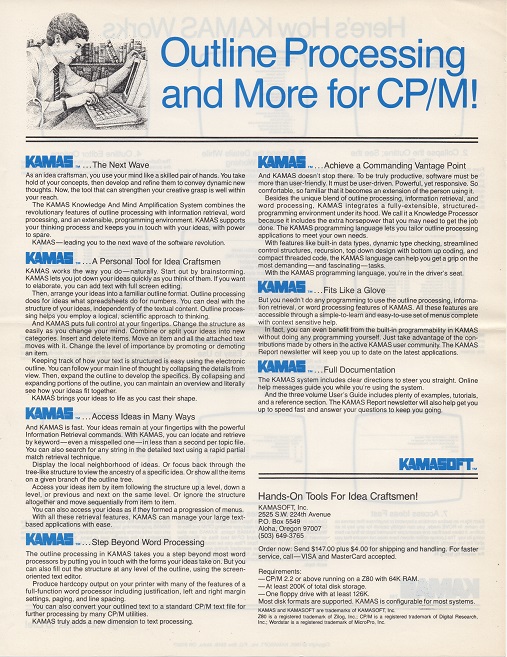
Click the following image which is a link to a .PDF file containing some scanned images of representative Kamasoft marketing material from 1985:
Some loyal former customers have web searched and found this website thereby eMailing us about how to convert their original .KAM file content into modern word processor documents or structured document formats. One customer wanted to revisit his original Doctorate thesis which was still residing in a Dos-KAMAS .KAM file.
The last major commercially supported versions Dos-KAMAS were distributed on 3.5 inch floppies (circa 1989, v. 2.33 for MS-DOS machines and FastLine for MS-DOS on palmtop machines). The main KAMAS.COM app is an ancient 16-bit binary DOS executable from those early days that predated the advent of .EXE executables. Even so, such .COM files could be executed for quite some time even into the era of Microsoft Windows (ie, 16-bit Win 3.* through Win98 to at least 32-bit Win-XP). With the advent of 16-bit Windows, versions of Dos-KAMAS included a KAMAS.PIF file to facilitate the ability to run Dos-KAMAS under what were only 16-bit versions of Windows back then (eg, v. 3.1). More on that here from the KAMAS v. 2.33 ReadMe.txt file:
12. KAMAS can be run as a "Standard Application" under Microsoft Windows. Included on the KAMAS master disk is the necessary KAMAS.PIF file to allow this. See your Microsoft Windows documentation for details. If you are not running KAMAS under MS-Windows, then you do not need the KAMAS.PIF file.
As recently as 32-bit Windows-XP, Dos-KAMAS v. 2.33 could run in XP's default "Command Prompt" Window. It is very likely that it would also similarly run under other 32-bit versions of the Windows OS beyond Win-XP. But the internal support to run those old 16-bit .COM files was discontinued in 64-bit versions of Windows (eg, in 64-bit XP/Vista/7/8/10/11 in their Command Prompt or "PowerShell" windows).
There have been some attempts at 16-bit DOS emulators to run in MS-Windows, Linux, or macOS. Those have been primarily aimed at the nostalgia of running those now-crude, but still fun, legacy character mode DOS games from that bygone era. The recent DOSBOX emulator runs under MS-Windows, Linux, and macOS (web search for "DOSBox"). It seems to run Dos-KAMAS surprisingly well (based on modest testing in DOSBOX v. 0.74-3 running on 32-bit Win-XP and, more importantly, on 64-bit Win-10). That said, there is absolutely no guarantee that Dos-KAMAS will run properly in all respects using DOSBOX's emulation of DOS. Dos-KAMAS requires full fidelity to the MS-DOS versions 3.3 through 6.22 that Dos-KAMAS was originally released to run on. Disclaimer: Other than downloading and briefly testing the free DOSBOX, Kamasoft has no relation whatsoever with the makers of DOSBOX. Use DOSBOX at your own risk.
One original owner of Dos-KAMAS tried to run it in DOSBOX, received an "Init Fail" during Kamas's signon and contacted us about it. This error can occur if Kamas cannot initialize its data access system. That user tried to run KAMAS.COM without its necessary accompanying factory-supplied *.KAM files located in the same directory as KAMAS.COM. During initialization KAMAS needs to setup its internal access method with at least one available .KAM file. It first looks for its most important HELP.KAM file but, lacking that, it looks for any other .KAM file to "lock onto" and finish all initialization. If it cannot find any .KAM file it exits with the "Init Fail" message. For minimal proper operation, Dos-KAMAS needs at least the following two files: KAMAS.COM and HELP.KAM. It should go without saying that all the product documentation assumes you are running with the complete factory package of KAMAS which included the following files in the v. 2.33 release:
On the issue of converting structured .KAM file data to other formats. For some years, despite an attempt to get it corrected, the Wikipedia article on KAMAS (link above) incorrectly stated that Dos-KAMAS had no way to export its structured outline content to a form that retained the outline structure. We'll clarify that here. At the time of KAMAS v.2.0 (circa 1986) we had worked with a few other prominent Outline Processor companies (eg, the respective producers of the ThinkTank and PC-Outline apps) to agree on and implement a markup standard for different Outliner apps by means of which they could Import/Export their proprietary outline contents into a very portable intermediate form which preserved hierarchical structure (We didn't have XML back then). KAMASOFT referred to that import/export format as a "Structured Ascii File" (SAF) markup standard. Of course KAMAS was competing in the market of the time with a variety of outliner applications that had cropped up after the success of original KAMAS on the CP/M operating system. And thus the Dos-KAMAS User Guide's emphasis was on how KAMAS could import outline content produced within other competing outliners. Of course Dos-KAMAS had multiple ways to output all or selected portions of its outlines as standalone word processor documents (Standard ASCII text files, Wordstar Document files, and Print Image files). In addition, contrary to the Wikipedia article, all Dos versions of KAMAS did indeed have a built-in facility to export its outlines to a portable file format that retained structure information (SAF files). A whole Section 5.11.2 of the Dos-KAMAS User's Guide on "Converting KAMAS Outlines into Text Files" was dedicated to this. In particular a section (5.11.3), "An Example of Converting Outline Files" in which an export to a Structured Ascii File was performed (on a selected branch of the DEMO.KAM topic file).
Here is a quick run through of the procedure in Dos-KAMAS that can export all or a portion of a Dos-KAMAS outline into an SAF Structured Ascii File. In this example case, the entire factory-provided DEMO.KAM outline is exported into an SAF text file. Yes, this can be done running Dos-KAMAS in either a 32-bit Windows Command Prompt window or in a DOSBOX. The process to export that entire KAM file outline is:
It's been almost 40 years since the time that Dos-KAMAS versions were last sold and supported. Official support for the KAMAS versions sold back then ended those many decades ago. Since that era, a host of sophisticated modern apps for authoring structured content have been on offer, each having its own native proprietary format. Structured KAMAS outline content need not remain trapped in that past. It can still be natively accessed (and edited) in a running KAMAS itself (as described above). Beyond that the SAF text format is one way modern app providers can import old KAMAS outlines while retaining content structure. Edit up that DEMOSAF.TXT text file (as exported above) in a text editor (eg, Notepad). You'll see that its markup coding is quite simple such that a competent programmer could write a rather vanilla app/routine to scan through such an ASCII text file and trigger off of the markup coding to reconstitute the original structured hierarchical content in some preferred proprietary form.
For those still around from those very earliest years of the personal computer revolution, the history aspect of this web page especially celebrates programmable CP/M KAMAS and the wide world of pioneering users who engaged the KAMAS quest way back then running on 8-bit microprocessors.
Email: